









We are now living in a digital era where having a highly efficient and functional web application is no longer just a luxury but a must. This is why more and more companies, businesses, and organizations across all industries that are considering a transition to online platforms are now investing to build their own web app. Nowadays, simply having a typical website or being present on various social media networks and other online platforms like online marketplace and blogs are not enough to build a good online presence and grow your e-business. If you want to stand out and set new trends in your industry, you need to also consider creating your own interactive web application. However, if you don’t know which web-based development application framework is perfect for your next web app project, below are two of the most popular and most loved web application frameworks available today. Read on to know more about these amazing web application frameworks.
Table of contents
The Best Web Application Frameworks for Web-based Applications
When it comes to developing a web application, one of the many considerations that you need to think of and plan ahead is choosing the right web application framework. The best option available for web app development companies and other developers is to use web application frameworks. Unlike coding from scratch, you will no longer have to begin everything from ground zero. The web application frameworks will allow you to keep your time and resources focused on developing new unique features for your web app.
Instead of killing time doing repetitive, mundane tasks of coding while your competitors are still busy reinventing the wheel, you are already starting to tighten up your app’s codebase and implementing its new features. This gives you a better edge as compared to your competitors. Whether you are building an online banking app, shopping cart web application, online forum, online training app, content management systems, social networking site, booking and reservation web app, an interactive web game, or any other web-based application, choosing the right framework will make your work less daunting and time-consuming. The market is now swarming with different web application frameworks- each of which offers unique features and technologies that promise to make your new web app an outstanding one.
You need to understand that each project is unique. This means that your next web app project would probably have different requirements from the other apps on the market or even from your current apps. This is why you need to study each available framework first before making a decision to know which one would best fit your next web application’s needs and requirements. We wrote this blog to help you make a well-informed decision and to know which between Ruby on Rails and AngularJS works best for your ideal web application. Head on and read the specifics of each of these two frameworks and see which fits well your needs and requirements.
Ruby On Rails vs AngularJS Quick Overview
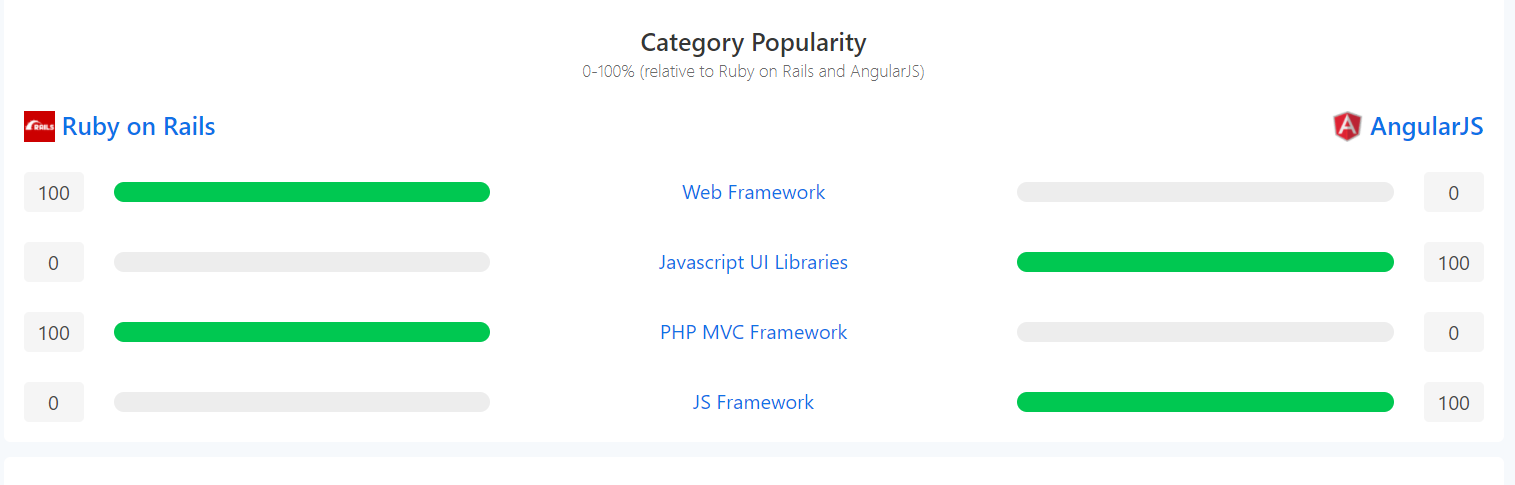
Two of the most widely known and popularly used web development apps today are Ruby On Rails and AngularJS. Though both offer unique features to the right projects, they differ from each other in many ways. Here is a quick comparison of the fundamental differences between Ruby on Rails and AngularJS architecture.
Overview: Ruby on Rails
Ruby on Rails, simply known as Rails, is free, open-source software built by David Heinemeier Hansson that is used to build web applications that run on a web server. It is a server-side web application development platform or framework that uses the general-purpose programming language Ruby. It is also an MVC or model-view-controller framework with MIT License. Ruby on Rails combines Ruby with computer programming languages such as CSS, HTML, and JavaScript to build a web-based application and for user interfacing. It also facilitates the use of JSON or XML web standards for data transfer. Apart from MVC, Ruby on Rails also accentuates the utilization of don’t repeat yourself (DRY), convention over configuration (CoC), active record pattern, and other popular software engineering patterns and paradigms.
Ruby on Rails timeline
Ruby on Rails was first launched in July 2004 as an open-source but only emerged in 2005. During its emergence, Ruby on Rails greatly impacted the web app development arena. Thanks to the framework’s innovative features like seamless migrations, the scaffolding of views, and database table creations. All these features and more make it possible for web app developers to build web applications faster. In August 2006, Apple declared that the company will ship its Mac OS X v10,5 “Leopard” with Ruby on Rails, marking a notable milestone on the framework’s timeline.
Below is the summary of the Ruby on Rails timeline.
When to use Ruby on Rails?
Professionals who offer web app development services use Ruby on Rails for many reasons and various web-based app development projects. While you can use Ruby on Rails in building a variety of web applications development projects like APIs, command-line tools, Java apps, hotel and booking applications, help desks, project funding services, data analytics platforms, trading and news web app, photo editing web app, business organizer and management tool, embedded apps, client-side apps, desktop games, and test suites for non-Ruby apps, it is more suitable for creating the following applications.
- Online stores
If you plan to build a decent online store that offers sophisticated purchasing and browsing options, Ruby on Rails is the best framework you can use. Do you want to create the next Shopify-like E-Commerce site? Ruby On Rails Developers will help you realize your revolutionary concept and make your idea a reality.
- Saas solutions
Ruby on Rails is an optimum choice for developing Saas solutions. Thanks to its easy building features like libraries, scaffolding, localization, convention over configuration, and automated testing.
- Social networking sites
Ruby on Rails is also an ultimate option for developing a web application and platform that allows you to meet and network with different people across the globe via social networking sites. One of the most popular social networking platforms today is Couchsurfing, a traveler-dedicated social networking service with more than 12 million users.
- Gaming livestream platforms
Game live streaming is getting in trend nowadays. This makes gaming Livestream web apps a viable project. Should you want to create a gaming live stream platform like Twitch. tv, consider using Ruby on Rails.
Contact Today. Save Upto 50% !
Overview: AngularJS
AngularJS is a structural, open-source web framework that is written in JavaScript. Maintained primarily by Google and a community of corporations and individuals, this framework is perfect for building single-page applications and dynamic web apps. AngularJS, also referred to as Angular 1, was launched in 2010 and created by Misko Hevery. This front-end structural framework under MIT License allows Angular web development professionals to use HTML as a template language. It also allows the Angular developers to succinctly and clearly express the primary components of their web applications by extending its HTML syntax. This makes the resulting environment quick to develop, highly readable, and remarkably expressive.
AngularJS simplifies the development and testing of applications. Its two-way data binding and dependency injection remove much of the code that the AngularJS development company needs to write. Moreover, AngularJS also provides a framework for MVVM or Model-View-ViewModel and MVC or Model-View-Controller architectures. Along with these architectures are the common components used in developing progressive web apps and web-based applications.
Contact Today. Save Upto 50% !
When to Use AngularJS?
AngularJS can be used to build web-based apps for different kinds of environments. This web development framework is suitable for applications like:
- Progressive web apps or single-page apps (PWA/SPA)
AngularJS is perfect for designing minimalist yet highly dynamic web apps. Among the examples of PWA/SPA are Twitter, Pinterest, Forbes (built with Angular), Starbucks, Trivago, and The Washington Post.
- Business-level web applications
AngularJS comes with a wide array of libraries where the Angular JS development company can save their work during the development project. It also features Typescript which allows the top web app developer to reuse components and different modules in designing web applications.
- Dynamic web applications
Dynamic web applications are those types of apps that generate and display data or pages in real-time according to the client who consumes the content and some components and the user who is accessing them. For instance, when you click the like button on a social media post, the respective response will be triggered and the respective action will be taken. If you want to build a dynamic web app like E-Commerce sites, to-do sites, and calendar web apps, AngularJS is a perfect choice. AngularJS is used by industry tycoons Gmail, Upwork, The Guardian, Wix WebApps, and PayPal, to name a few. Whilst, well-known sites and web apps like
AngularJS vs Ruby on Rails Comparison