150+ minds across 4 countries. Join a culture of innovation, ownership & growth.
Rewire for AI
From machine learning to deep learning, from classification tools to overall process automation – our AI engineers will help you retool your existing system or enhance your company results.
Ship faster, scale smarter, built for product companies and SaaS teams
Our Latest Work
We strive hard to deliver result-driven digital solutions across the globe. Check out our case studies to get a glimpse of how we ideate, innovate, and create unconventional digital solutions according to the requirements of our clients.
Discover diverse and passionate insights from our tech enthusiasts. We collaborate across various sectors to streamline operations and drive innovation. Explore our rapidly growing collection of articles to see why we’re at the forefront of IT solutions.
The decision to move from Magento to Shopify is one of the most significant replatforming choices an ecommerce business can make. Magento is powerful, but its power comes with...
Accuracy gap is real: Traditional CPG forecasting carries a 25-40% MAPE error rate. AI-powered models bring that down to 8-15%, according to McKinsey research....
Real stories from global leaders who trusted us with their ideas.
Partnering with APPWRK helped us build a compliant and scalable healthcare platform, accelerating our time-to-market by 35%. Their team consistently delivered outstanding work.
Beesers
Digital Healthcare Client
Collaborating with APPWRK, Sportskeeda modernized its platform into a real-time sports engagement ecosystem, enabling seamless content delivery, scalable fan interactions, and high-velocity performance.
Sportskeeda
Sports & Entertainment Partner
Working with APPWRK was effortless. They captured our vision, maintained full compliance, and delivered a digital experience that built trust and elevated how customers interact with our fintech brand.
PayPenny
Fintech Partner
Working with APPWRK gave us confidence in adopting AI responsibly. Their team built a safe, intelligent bot that transformed how we engage with leads and helped us achieve measurable revenue growth.
IFB
AI Transformation Partner
Leveraging APPWRK’s digital expertise, Nemesis launched a scalable, compliant, and safe super app that connects content delivery, real-time communication, and logistics management within a single platform.
The cost to develop an AI stock trading bot typically starts at $10,000 for a minimum viable product (MVP) and can exceed $200,000-$500,000+ for enterprise-level platforms. Key cost drivers include AI model sophistication, real-time data processing, compliance requirements, and the development team’s location.
AI stock trading bot development costs start at $10,000 for a minimal viable product (MVP) and can exceed $500,000 for enterprise-scale platforms with deep learning, real-time data analytics, and cross-asset trading capabilities.
The global AI trading market is accelerating rapidly, projected to surpass $31 billion by 2029, fueled by rising demand for intelligent automation, predictive analytics, and real-time decision-making in increasingly volatile financial environments.
Smart development choices, like deciding between in-house teams and outsourcing, or strategically using open-source frameworks, can cut AI trading app development costs by as much as 30-50%, without compromising on performance or scalability.
High-performing trading bots rely on quality datasets, algorithm transparency, and continuous model training to remain compliant with financial regulations and responsive to market changes.
AI trading apps unlock multi-channel monetization through subscriptions, in-app purchases, premium data sales, and technology licensing, offering scalable revenue streams for fintech founders and institutional investors.
Whether you're aiming to launch a lean prototype or scale an AI-driven trading platform across global markets, every C-suite leader, founder, or investor must understand the full cost breakdown, development process, and compliance roadmap to ensure sustained growth and competitive edge.
Global Market Overview and Expansion
AI stock trading bots have evolved from niche experiments into indispensable engines powering the future of financial markets. As globalization fuels complexity and data volumes soar, these intelligent systems are revolutionizing trading through advanced predictive analytics, real-time sentiment interpretation, and dynamic portfolio optimization, fundamentally transforming how capital flows and risk is managed across the globe.
Key Market Trends of AI in Trading
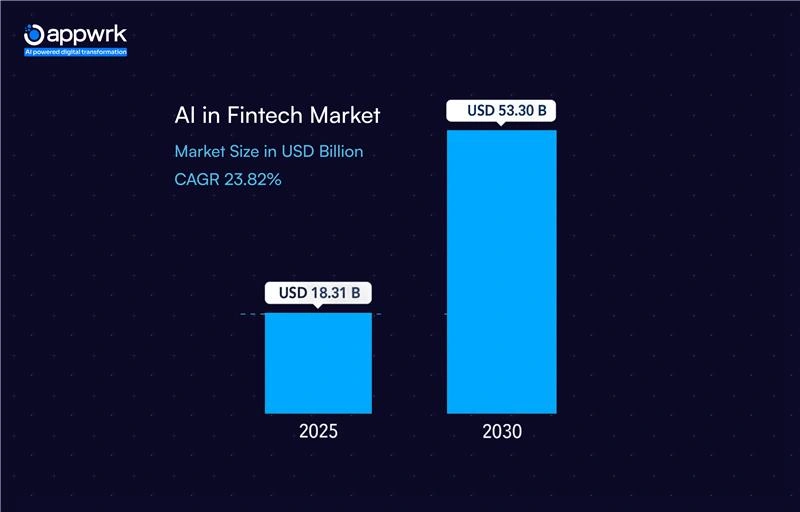
The AI In Fintech Market size is estimated at USD 18.31 billion in 2025, and is expected to reach USD 53.30 billion by 2030, at a CAGR of 23.82% during the forecast period (2025-2030).
More than 58% of hedge funds and institutional traders are using AI tools to drive decisions, risk analysis, and real-time market execution.
AI-powered trading platforms are leading in user acquisition across retail and institutional segments due to their 24/7 market responsiveness and lower error margins.
By 2026, over 65% of digital trading platforms will have integrated AI agents for trade recommendation, compliance checks, and predictive risk modeling.
The Growing Demand for AI Trading Bots & Apps
The growing demand for AI trading bots and apps is evident in global financial centers like New York and Singapore, where the financial sector is rapidly investing in algorithmic and AI-powered automation. This momentum is fueled by the need for faster trade execution, improved predictive accuracy, and smarter decision-making in today’s complex and data-driven markets. The primary drivers include:
Rising retail investor participation through mobile-first platforms
Increased volatility post-pandemic, which favors real-time AI decision-making
Growing demand for personalized investment portfolios
Even small-cap fintech startups are building AI trading bots to gain user traction through intelligent automation and real-time asset recommendations.
AI Adoption in Financial Markets (2025 and Beyond)
In 2025 and beyond, AI will shift from being an execution tool to becoming an autonomous advisor across asset classes. Here’s what to expect:
AI agents will handle portfolio rebalancing, tax-loss harvesting, and multi-asset correlation analysis.
Trading platforms will integrate natural language processing (NLP) to convert real-time news into trading signals.
Regulatory sandboxes in regions like the UK, Singapore, and UAE will allow fintech startups to test AI models under guided frameworks, driving safer adoption.
What Are AI Stock Trading Bots and How Do They Work?
AI stock trading bots and apps represent a fusion of financial theory, algorithmic trading, and artificial intelligence. These tools are designed to analyze market data, generate insights, and execute trades at speeds and accuracies far beyond human capabilities.
What is an AI Stock Trading Bot?
An AI stock trading bot is an automated software agent that uses artificial intelligence to make trading decisions based on market data, technical indicators, sentiment analysis, and predictive modeling. These bots are capable of executing trades autonomously and continuously adapting their strategies based on historical and real-time inputs.
Unlike traditional rule-based bots, AI bots learn from data using machine learning, neural networks, or reinforcement learning, enabling them to optimize strategies dynamically.
AI Trading Bot Functionality: How They Analyze, Predict, and Trade
AI trading bots process structured and unstructured data, including charts, financial news, social sentiment, and macroeconomic indicators, to:
Predict market direction
Identify trade opportunities
Calculate risk-to-reward ratios
Execute trades in real-time
Advanced bots integrate natural language processing (NLP) to interpret news, computer vision to analyze charts, and deep learning for pattern recognition across asset classes.
Automated Trading Systems vs AI Bots: Key Differences
An automated trading system (ATS) is a rules-based software framework that allows the automatic execution of trades based on predefined conditions. While not all ATSs are AI-powered, modern platforms increasingly embed AI to improve predictive accuracy and strategy refinement.
AI enhances ATS through:
Adaptive learning based on outcomes
Intelligent rebalancing
Risk-aware trade sequencing
How AI in Stock Trading Apps Works
AI in trading apps functions as a decision-making core that:
Scans live data feeds for trade triggers.
Learns from past trades and market behavior.
Adjusts its strategy based on performance.
Communicates decisions via app interfaces or APIs.
These apps often feature custom dashboards, alerts, and backtesting environments that empower traders to experiment with AI-augmented strategies.
Types of AI Trading Bots: Scalping, Sentiment, Arbitrage, and More
There are several bot variants based on functionality and strategy:
Type
Functionality
Scalping Bots
Execute high-volume trades with narrow spreads.
Momentum Bots
Identify and ride price trends.
Arbitrage Bots
Exploit price differences across exchanges.
Mean Reversion Bots
Trade based on the assumption that prices will revert to the mean.
Sentiment Analysis Bots
Trade based on news, tweets, and social media indicators.
Retail vs. Institutional AI Trading Apps: Feature Breakdown
Apps can vary in sophistication and use-case:
Retail AI Apps like Robinhood, Alpaca, and eToro integrate lightweight AI features for basic automation and insights.
Institutional Platforms such as Thinkorswim and Interactive Brokers include algorithm customization, direct market access, and advanced analytics.
White-label AI trading apps allow fintech companies to build branded platforms using core AI engines.
AI App for Crypto & Stocks
Modern AI bots are multi-asset capable. They’re used in:
Stock trading for predicting S&P500 movements, earnings-based volatility, or technical levels.
Crypto markets for arbitrage, volume analysis, and sentiment tracking.
Cross-asset bots that analyze correlations between forex, commodities, and equities.
Cost Breakdown: Building AI Stock Trading Bots & Apps
When estimating the cost to develop an AI stock trading bot, it’s essential to understand the variables influencing the final investment, from model sophistication to regulatory readiness. Development costs span architecture, AI training, UI/UX, cloud integration, and compliance layers.
AI Stock Trading Bot Development Cost Breakdown
Here’s a breakdown of typical development costs based on phases:
Phase of AI Stock Trading Bot Development
Cost Range for AI Stock Trading Bot Development
Key Components
MVP Development
$10,000 to $55,000
Basic AI logic, historical data backtesting, and UI dashboard.
Mid-Tier AI Bot
$60,000 to $180,000
Live trading, NLP news sentiment, and cloud deployment.
Enterprise-Grade Platform
$200,000 to $500,000+
Multi-asset trading, deep learning, and global compliance.
These ranges can shift depending on team structure, geographic location, and depth of AI integration.
Cost of Developing an AI Trading Bot
On average, building a production-ready AI trading bot involves:
Costs scale significantly for bots requiring real-time execution, zero-latency architecture, and predictive accuracy through reinforcement learning.
Cost to Build AI Trading Apps Like Thinkorswim, Moomoo & Robinhood
Thinkorswim is a fully loaded trading platform offering complex charting, real-time analysis, and high-frequency trade execution. Replicating or competing with such an app would cost:
Initial development: $250,000 to $500,000+
Ongoing model tuning and cloud hosting: $100,000+ annually
Compliance & legal reviews: $25,000 to $75,000+
Data licensing (e.g., Refinitiv, Nasdaq): $10,000 to $60,000 annually
These platforms often use proprietary AI and require compliance audits from FINRA, SEC, and MiFID II, depending on the jurisdiction.
For a Moomoo-style platform that includes real-time data, technical charting, and social community integration, costs typically range between $150,000 and $350,000, depending on the AI depth and exchange integrations.
Robinhood-like apps with AI features such as risk alerts, portfolio rebalancing, and in-app education modules range from $100,000 to $300,000.
Factors Affecting Development Cost
The cost to develop an AI stock trading bot is influenced by a variety of technical and operational factors. Understanding these variables is crucial for accurately estimating the investment required and aligning it with your project goals.
AI complexity (supervised vs. unsupervised learning)
Volume and quality of historical data
Real-time vs. delayed execution
Multi-asset vs. single-asset logic
Security and compliance layers
Scalability for high-frequency trading
Choosing pre-trained models or using open datasets can cut costs by 20% to 30%, but at the expense of customizability.
Cost Comparison by Bot Type
Bot Type
Cost Range of the bot development by type
Notes
Basic Rule-Based Bot
$10,000 to $30,000
Operates without AI, relying solely on predefined, fixed trading strategies.
AI-Powered Equity Bot
$50,000 to $150,000
Includes predictive ML models.
Crypto Arbitrage Bot
$30,000 to $120,000
Integrates with Binance, Coinbase, etc.
Sentiment AI Bot
$80,000 to $200,000
NLP + market data + multi-source news.
Enterprise Hybrid Bot
$200,000 to $500,000+
Real-time execution, ML retraining, risk models.
Moomoo vs. Thinkorswim vs. Robinhood: AI Trading Features and Development Cost Comparison
Feature / Cost Factor
Moomoo
Thinkorswim
Robinhood
AI Sentiment Analysis
Yes
No
Beta version
Paper-Trading Environment
No
Full
No
Technical Indicators
60+
100+
Limited
Crypto Trading Support
Yes
Partial
Yes
Compliance Features (KYC/AML)
Built-in
Built-in
Built-in
Cost to Develop
$150,000 to $300,000
$250,000 to $500,000+
$100,000 to $250,000
These platforms represent distinct product strategies. Moomoo focuses on AI-based investor tools like sentiment scanning and education. Thinkorswim prioritizes depth for pro traders with extensive technical analysis and paper trading. Robinhood emphasizes accessibility and supports lighter AI features. Your development scope should match the complexity and compliance expectations of your user base.
Cost by Region (USA, UK, Australia, Europe)
Region
Hourly Rate of the AI Trading Bot Development
Impact on Cost
USA
$120 to $200/hr
Highest quality and strictest compliance.
UK/Europe
$80 to $150/hr
GDPR-ready and MiFID II focused.
Australia
$70 to $120/hr
Balanced in skill and cost.
India/Asia
$30 to $75/hr
Cost-effective for startups and prototypes.
Offshore development can reduce costs by 40-60%, but requires strong project management and IP safeguards.
Technology Stack for AI Trading App Development
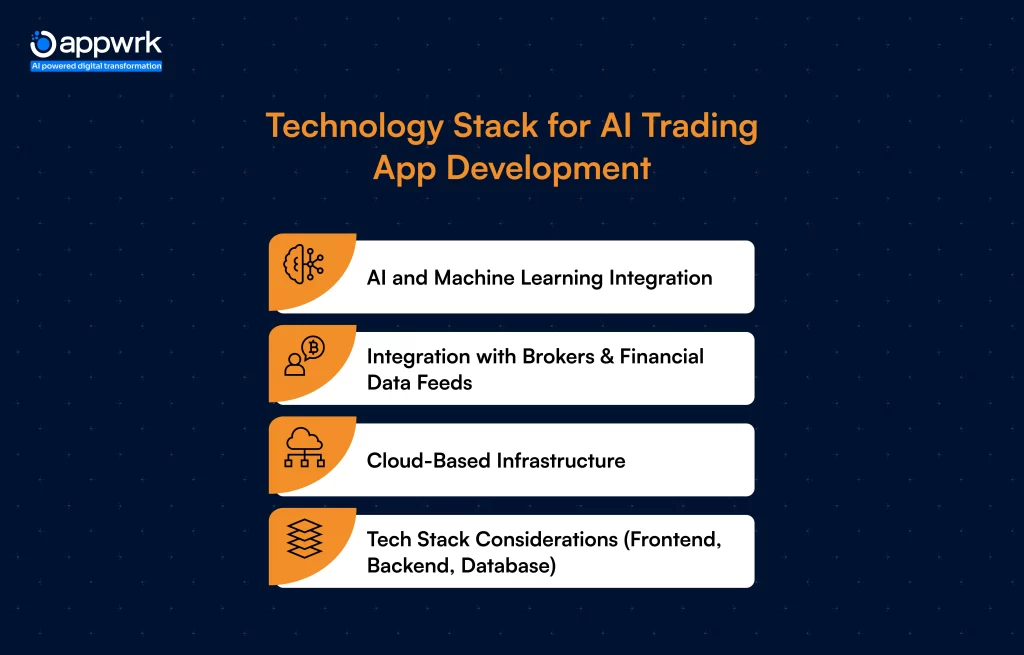
It goes without saying that building a powerful AI trading app starts with choosing the right technology stack. This stack must enable lightning-fast data processing, seamless real-time analytics, efficient machine learning workflows, and stringent security measures to meet regulatory standards. The technology choices you make today will shape your app’s performance, scalability, and ability to adapt to future market demands.
AI and Machine Learning Integration
For AI functionality, Python remains the language of choice due to its rich ecosystem of libraries like TensorFlow, PyTorch, and Scikit-learn. Reinforcement learning algorithms such as Deep Q-Networks and Proximal Policy Optimization are often used for strategy training.
For data processing and orchestration, Apache Kafka and Apache Airflow are widely adopted. These ensure seamless data ingestion, transformation, and ML model triggering in a production-grade pipeline.
Model performance monitoring tools like MLflow and Seldon Core allow for real-time feedback and versioning, crucial in dynamic financial markets.
Cloud-Based Infrastructure
Modern AI trading platforms are hosted on cloud-native infrastructure to ensure elasticity and high availability. Providers like AWS, Google Cloud, and Azure offer:
Managed Kubernetes for container orchestration
Auto-scaling GPU instances for model training
Data lakes and warehouse solutions like BigQuery or Redshift
Real-time stream processing with services like AWS Kinesis or Google Pub/Sub
Cloud-native setups reduce overhead, support global deployment, and offer in-built compliance modules for financial standards.
Frontend frameworks such as React or Vue.js enable responsive, modular interfaces for traders. These are often integrated with WebSockets for real-time data streaming and dynamic charting libraries like Highcharts or D3.js.
Backend systems are typically built using Node.js, Django, or FastAPI, enabling asynchronous trade execution and efficient API handling. Event-driven architectures are crucial for latency-sensitive trading environments.
PostgreSQL, MongoDB, and TimescaleDB are common choices for structured and time-series data. For scalable caching and fast query responses, Redis and ElasticSearch are integrated.
Integration with Brokers & Financial Data Feeds
Brokerage APIs such as Alpaca, Interactive Brokers, and TD Ameritrade enable direct market access. FIX protocol support is essential for institutional-grade execution and interoperability with trading venues.
Financial data feeds, including stock quotes, order books, earnings calendars, and macroeconomic indicators, are sourced from platforms like Refinitiv, Xignite, or Polygon.io. These are fed into AI pipelines via secure APIs and ETL layers.
Webhook and RESTful integrations ensure real-time synchronization between data providers, brokers, and the AI engine, creating a unified, responsive system.
Use Cases of AI Trading Bots and Apps
AI-driven trading solutions have progressed far beyond simple automation. Today, they serve as powerful tools that enhance investment decision-making, identify fraudulent activities, manage portfolio risk, and respond dynamically to shifting market conditions. For executives and fintech pioneers, these applications represent key areas where AI drives competitive edge and measurable value.
Personalized Portfolio Management
AI-powered trading platforms enable dynamic portfolio creation based on an investor’s risk appetite, financial goals, and market behavior.
Using clustering algorithms and real-time feedback loops, bots rebalance portfolios and offer hyper-personalized investment pathways, significantly enhancing investor retention and satisfaction.
Fraud Detection
AI in trading systems excels at detecting anomalous trading patterns and malicious behaviors like:
Wash trading
Front running
Spoofing
By continuously analyzing trading activity against known threat models, AI agents can flag and respond to fraud in real time, reducing regulatory risk and building investor trust.
AI-Enhanced Robo-Advisors
Modern robo-advisors integrate:
Natural language processing to interpret financial news.
Machine learning to adapt asset allocations.
Goal-based planning features tailored to user objectives.
This enhances traditional robo-advisory models by bridging personalization with predictive intelligence.
AI-Powered Risk Management
AI supports both pre-trade and post-trade risk management by:
Monitoring exposure across asset classes.
Predicting tail-risk events through simulation.
Adjusting trading behavior based on volatility indicators.
For institutional platforms, this can dramatically reduce Value at Risk (VaR) and exposure to black swan events.
Predictive Analytics for Stock Movements
AI-driven predictive analytics use vast amounts of market and external data to identify trends and forecast price changes. By continuously analyzing key factors, these systems provide traders with actionable insights to stay ahead in dynamic markets.
Chart patterns
Macro indicators
Social sentiment
Historical volatility
AI models carry these processes to generate actionable predictions on stock price movement. Models like LSTM, ARIMA, and reinforcement learning agents are widely used in AI trading apps to stay ahead of the market.
Automated Trading Execution
Bots can execute trades based on:
Technical breakouts
Arbitrage signals
Stop-loss levels
Market news events
This ensures 24/7 coverage across global exchanges, especially valuable in crypto and FX markets.
Real-Time News and Sentiment Analysis
AI bots consume and analyze data from:
Financial news feeds (Bloomberg, Reuters).
Reddit, Twitter, and forums.
CEO earnings calls and economic speeches.
They then convert sentiment shifts into trading triggers using NLP and sentiment scoring models.
Multi-Asset Support and Exchange Integration
Advanced AI bots offer support for:
Stocks
ETFs
Options
Crypto
Forex
They integrate with APIs from NASDAQ, NYSE, Binance, Kraken, and more, providing a unified trading experience.
Step-by-Step: How to Develop an AI Stock Trading Bot or App
Creating a high-performing AI stock trading bot or app involves a structured approach that blends trading expertise, machine learning, and robust software engineering. Business owners and CTOs must orchestrate the right mix of domain knowledge, technical talent, and infrastructure readiness to deliver a scalable solution.
Step 1: Define Your Trading Goals
Every successful AI trading system begins with clarity. Clearly define the asset classes you want to target, the markets to operate in, and the trading objectives, whether it’s alpha generation, arbitrage, or long-term portfolio optimization. Align goals with user personas and compliance boundaries before writing a single line of code.
Step 2: Design the Trading Logic
Once goals are mapped, the next step is strategy design. This involves formulating hypotheses around technical indicators, trend patterns, or event-driven strategies. Experts often create both rule-based frameworks and adaptive logic to allow for performance benchmarking before full AI integration.
Step 3: Choose the Right Tech Stack
Select a scalable, modular tech stack that supports real-time data processing and AI model deployment. Python, TensorFlow, FastAPI, and PostgreSQL are common choices for backend and ML workloads, while React and Flutter dominate front-end frameworks. Consider latency-sensitive infrastructure if high-frequency execution is required.
Step 4: Data Gathering and Preparation
Data is the fuel for your AI models. Acquire quality datasets including historical price feeds, order books, news articles, and alternative data like social sentiment. Preprocessing, cleaning, normalizing, and labeling are critical for model accuracy. Data partnerships with providers like Refinitiv or Alpha Vantage can accelerate access to premium feeds.
Step 5: AI Model Training & Managing Drift in Trading Bots
At this stage, developers using machine learning techniques like reinforcement learning are ideal for environments with model drift, where the bot’s assumptions shift with changing market behavior. Developers should also implement feedback loops and validation protocols to detect and adapt to such drifts early.
Understanding Model Drift in Financial AI
Model drift refers to the gradual degradation in model performance due to changes in market behavior, economic cycles, or external events (like pandemics or political shocks). In trading bots, this leads to inaccurate signals or underperformance. Two types are common: data drift (input changes) and concept drift (underlying pattern change). Mitigating drift involves ongoing retraining, drift detectors, ensemble models, and using a sliding training window. Platforms like Seldon, Alibi-Detect, and Amazon SageMaker Clarify offer model drift detection tools compatible with trading data environments.
Step 6: Designing Low-Latency Execution Engines for Trading Bots
The execution engine translates AI decisions into market actions. It must support latency optimization, especially in high-frequency crypto or arbitrage bots, where microseconds can impact profitability.
Latency Optimization Techniques
In AI-driven trading, every millisecond matters. Latency can originate from slow APIs, inefficient execution logic, or geographically distant servers. Key optimizations include colocating servers with exchange data centers (e.g., NYSE, Binance), using WebSockets instead of REST APIs, implementing GPU-accelerated order routing, and caching market data locally. For high-frequency strategies, use UDP over TCP protocols, asynchronous queuing systems, and zero-copy memory techniques to reduce transmission delays.
Building a resilient, low-latency system that handles edge cases, like slippage and failed orders, ensures reliability in volatile market conditions.
Step 7: QA Testing and Paper-Trading Engine Deployment for AI Bots
Testing spans unit tests for components, regression testing for strategy stability, and paper trading to simulate live conditions. Use sandbox environments or paper trading engines to validate algorithmic strategies without capital risk before real deployment. Once validated, the app is deployed using CI/CD pipelines with containers or cloud-native orchestration tools like Kubernetes. Deployment should prioritize uptime, rollback capability, and model observability.
Designing the Perfect Trading Experience
Let’s face it, a powerful AI trading engine alone cannot guarantee success without a seamless, intuitive, and trustworthy user interface. For fintech platforms to achieve wide adoption and sustained engagement, the user experience must cater to traders of all expertise levels—offering clarity, actionable insights, and ease of use.
UI/UX design is not merely a visual or usability challenge; it serves as a strategic lever that directly impacts revenue, customer retention, and operational efficiency. By reducing training overhead and fostering user confidence, thoughtful design becomes a key factor in boosting trading volumes and maximizing lifetime value across user cohorts.
Design Requirements and Considerations
Design begins with understanding the psychological profile of your target users, from retail traders checking positions during commutes to institutional analysts needing deep data dives. Key considerations include clarity in data visualization, ease of trade execution, and a minimal learning curve.
Security features such as two-factor authentication, encrypted access, and role-based permissions must be integrated into the design flow without compromising usability. Consistency, accessibility, and responsiveness across devices are non-negotiable for apps operating in high-risk financial environments.
Creating a User-Centric Interface for Traders
An effective trading UI anticipates user intent and presents the most relevant information contextually. Real-time price updates, predictive trade suggestions, and visual risk indicators improve decision-making speed.
Intuitive dashboards that provide portfolio health, exposure metrics, and AI model confidence scores help build trust in the technology. Features like dark mode, keyboard shortcuts, and modular widgets are becoming standard in trader-centric design systems.
Mobile vs. Web Design Patterns in Fintech
Mobile-first design is essential for capturing the retail market, while web-based portals dominate the institutional segment. Mobile apps should prioritize swipe-based interactions, biometric login, and offline access to key data.
Web platforms, on the other hand, can afford to be more feature-dense, enabling advanced charting tools, bulk trade uploads, and integrated research terminals. A responsive design approach ensures cross-platform parity, but feature prioritization must remain platform-specific for optimal engagement.
Ensuring Quality: Testing and QA Best Practices
In AI-driven trading applications, quality assurance goes beyond code stability; it encompasses financial accuracy, model robustness, and strict regulatory compliance. Every feature, prediction, and trade execution demands rigorous testing to prevent costly mistakes and maintain user trust in automated decision-making.
For founders and CTOs, integrating comprehensive QA processes from the earliest development stages is crucial to building a credible, reliable product that stands up to the high stakes of financial markets.
Unit Testing, Regression, and Load Testing
Start with unit testing to validate individual modules like trade signal generators, API handlers, and UI components. These tests ensure that isolated logic performs as expected.
Regression testing comes next. Since AI models are constantly retrained, regression tests validate that updates or new data do not introduce bugs or change expected outputs. For financial apps, this includes ensuring no unexpected changes to pricing, risk calculations, or order logic.
Load testing is critical for platforms expecting real-time data flow or high-frequency trading. Simulate traffic surges, API spikes, and peak trading hours to ensure the system performs consistently under pressure. Latency metrics, especially for execution engines, must remain within acceptable thresholds across environments.
AI-Specific Testing Considerations
Unlike traditional software, AI systems are probabilistic and require additional QA layers. Key tasks include:
Validating the training dataset for bias, redundancy, and representativeness
Evaluating model precision, recall, and accuracy across asset categories
Testing edge cases in price prediction and anomaly detection
Monitoring for concept drift, where the model’s assumptions change due to evolving market patterns
A/B testing of model versions in paper-trading environments is also standard, allowing teams to deploy the most effective variant based on live performance.
Agile QA Methodologies
Agile QA frameworks are particularly well-suited for AI development, where continuous model improvement is a norm. Test automation must be part of the CI/CD pipeline, enabling fast feedback on new code pushes and model updates.
Collaborate across QA, data science, and product teams to define acceptance criteria that reflect both technical and financial performance. Incorporate feedback loops from real users and test environments to refine QA scripts iteratively.
Use agile management tools like Jira, TestRail, or Zephyr to track test coverage, identify bottlenecks, and document test outcomes, especially those tied to financial KPIs or regulatory metrics.
How to Reduce AI App Development Costs
The cost to develop an AI stock trading bot can escalate quickly if not managed strategically. Startups and mid-stage fintech firms can optimize their budget without compromising performance by aligning technical decisions with business priorities. Reducing AI development costs doesn’t mean cutting corners, but it means being smart with scope, technology, and resource allocation.
Build an MVP First
Instead of targeting a full-featured AI platform from the start, build a minimum viable product (MVP) that validates your core idea. Focus on one trading strategy, one asset class, and a limited set of user features. This enables early market feedback, reduced time-to-market, and lower risk. It also makes fundraising and stakeholder buy-in easier when there’s a working prototype.
Open-source libraries and frameworks like TensorFlow, Keras, PyTorch, FastAPI, and React significantly cut down on licensing and development time. For market data and analytics, platforms like Alpha Vantage, Yahoo Finance APIs, and CCXT (for crypto trading) offer accessible data without costly enterprise contracts. Leverage pre-trained models and public datasets where accuracy demands allow.
Outsource vs. In-House Development
For early-stage companies, outsourcing AI app development to a specialized vendor can save up to 40% in total cost. Offshore teams bring deep technical talent at competitive rates, provided there is a strong management and IP protection framework in place.
For core algorithm development and compliance-sensitive layers, consider a hybrid approach: outsource the scaffolding and UI components, but keep AI logic and data ownership in-house to protect your edge.
Reuse Code and Components
Maximize development efficiency by building on existing, battle-tested modules rather than starting from scratch. Utilizing reusable components, such as data pipelines, visualization tools, and trade execution engines, speeds up delivery and reduces risk. A modular, plug-and-play architecture empowers teams to work in parallel, ensures easier maintenance, and supports scalable growth. Consistent documentation and shared libraries further streamline collaboration and future-proof your AI trading app development.
Optimize Feature Set
Focus on delivering a lean, high-impact product by carefully selecting features that directly address your core user needs and business goals. Adding unnecessary functionality can quickly inflate costs, complicate development, and introduce testing challenges. By prioritizing essential capabilities upfront and leveraging user feedback and analytics, you ensure resources are invested where they generate the greatest return.
Security & Compliance in AI Trading Apps
Security and compliance are mission-critical when developing AI-powered trading apps. These platforms handle sensitive user data, interact with financial markets, and often execute trades autonomously. A single security flaw or compliance breach can result in regulatory penalties, financial losses, or permanent damage to brand reputation. Businesses must design systems that are secure by default and compliant by design.
Security & Compliance Considerations for AI Trading Bots
AI bots must operate within strict security protocols to prevent unauthorized access, data leaks, or trade manipulation. Use strong encryption standards, secure authentication (including multi-factor authentication), and strict access control policies for sensitive operations. Logs of AI decisions and trade executions should be immutable and auditable.
Additionally, ensure the bot adheres to compliance frameworks like SOC 2, PCI DSS (if handling payments), and GDPR if operating in Europe. Audit trails for AI decisions help with transparency and regulatory defense.
Regulatory and Compliance Standards
Depending on your target market, AI trading apps may need to align with:
FINRA and SEC in the US
MiFID II across the EU
ASIC in Australia
FCA in the UK
These frameworks require platforms to demonstrate algorithmic transparency, explainability in decision-making, and proper risk disclosures. AI models that autonomously execute trades should include mechanisms to pause or override decisions during market anomalies or unexpected outputs.
Risk-Free AI Trading Strategies
To avoid exposing users to high-risk behaviors, AI trading platforms can implement constrained learning environments. For example:
Limit trade sizes based on user profiles.
Simulate trades in sandbox mode before full execution.
Use reinforcement learning only in offline or backtesting environments.
Risk management layers should be embedded at both the AI model and execution logic levels, allowing for overrides, alerts, and throttling.
From a CFO’s perspective, these features help contain exposure, support internal controls, and align AI autonomy with governance structures demanded by institutional investors.
Secure Infrastructure Design
The infrastructure supporting your AI trading platform must be hardened against external and internal threats. This includes:
Secure APIs with rate limiting and token-based access.
Firewalls and intrusion detection systems.
Isolated environments for model training and live execution.
Continuous vulnerability scanning and patching.
Cloud providers like AWS and GCP offer compliance-ready infrastructure with pre-certified environments, which can fast-track your security audits and regulatory onboarding.
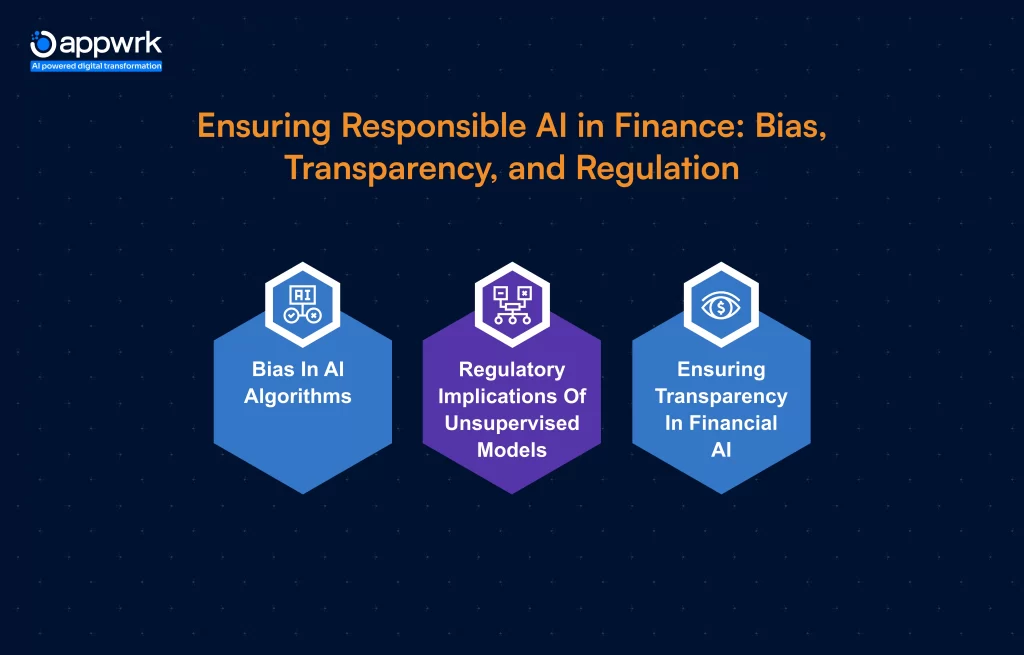
Ensuring Responsible AI in Finance: Bias, Transparency, and Regulation
In the high-stakes world of finance, AI isn’t just a tool; it’s a decision-maker that can shape market dynamics and impact real lives. Ensuring ethical AI practices is crucial not only to comply with evolving regulations but also to build trust and safeguard fairness. For founders and financial executives, embedding transparency, mitigating bias, and upholding accountability throughout AI development are essential pillars for sustainable success and market integrity.
Bias in AI Algorithms
Bias can infiltrate AI trading models through historical data, feature selection, or unintended correlations. For example, if the model favors certain asset classes or trading patterns due to skewed training data, it may consistently underperform or behave unpredictably under new market conditions.
To mitigate bias:
Use diverse, multi-source datasets.
Implement fairness metrics during model validation.
Regularly audit model decisions against actual market behavior.
Transparency into model rationale, especially when executing high-volume trades, is essential for compliance and investor trust.
Regulatory Implications of Unsupervised Models
Unsupervised learning models like clustering or anomaly detection are powerful tools in financial AI, but they come with opacity. Unlike rule-based or supervised models, they often cannot explain why a specific pattern was flagged or a trade was executed.
Regulators increasingly demand explainability. This means firms using unsupervised AI must implement documentation, human oversight, and fallback mechanisms that demonstrate control and auditability. Adopting AI governance frameworks ensures these models remain within regulatory and ethical boundaries.
Ensuring Transparency in Financial AI
Transparency isn’t just about explaining predictions, but it’s about making the entire AI decision-making pipeline accessible. This includes:
Logging model inputs, decisions, and outcomes.
Using interpretable models or applying explainability tools like SHAP and LIME.
Offering user-facing explanations for recommendations or trade signals.
In high-stakes environments like stock trading, this transparency reduces the risk of unaccountable behavior and aligns the platform with investor expectations and compliance norms.
AI Trading App Launch and Go-to-Market Strategy
Launching an AI-powered trading app demands more than just technical readiness. It requires a targeted, data-driven go-to-market (GTM) strategy that aligns with investor personas, regulatory timelines, and platform readiness. For fintech founders and C-suite leaders, this is where product, marketing, and legal strategy converge to ensure successful user acquisition and brand positioning.
Planning an Effective Launch
Before launching the AI trading app, validate your platform through alpha and beta testing phases. Alpha testing ensures internal performance across AI models, trade execution, and backend systems. Beta testing allows early adopters to engage with the product, report bugs, and provide usage feedback, which is critical for refining onboarding flows and trade usability.
Build a detailed launch checklist that includes final regulatory approvals, app store submissions, compliance documentation, and technical scaling tests. Time your launch to coincide with market sentiment, for example, earnings seasons or retail investor surges for added traction.
Building Hype and Investor Interest
Generate pre-launch buzz through thought leadership and market education. Publish whitepapers, expert blogs, and videos demonstrating how your AI bot outperforms traditional methods. Host webinars with financial influencers or backtest result showcases to build credibility.
Engage early investors and users via exclusive access programs or tiered incentives. Strategic use of LinkedIn, Reddit trading forums, and fintech newsletters can attract both tech-savvy investors and B2B partners. Secure media coverage by aligning your launch narrative with broader fintech trends, such as AI adoption or retail investing booms.
App Store and Web Platform Strategy
Your app’s discoverability is just as crucial as its backend performance. For mobile apps, ensure you meet the design, privacy, and financial app criteria of the Apple App Store and Google Play. Optimize metadata with financial keywords, include explanatory visuals, and maintain frequent update logs for higher ranking.
On web platforms, implement technical SEO with structured data, page speed optimization, and investor-centric landing pages. Provide downloadable whitepapers and ROI calculators to capture leads. For enterprise clients, include API documentation and sandbox access to encourage integrations and partnerships.
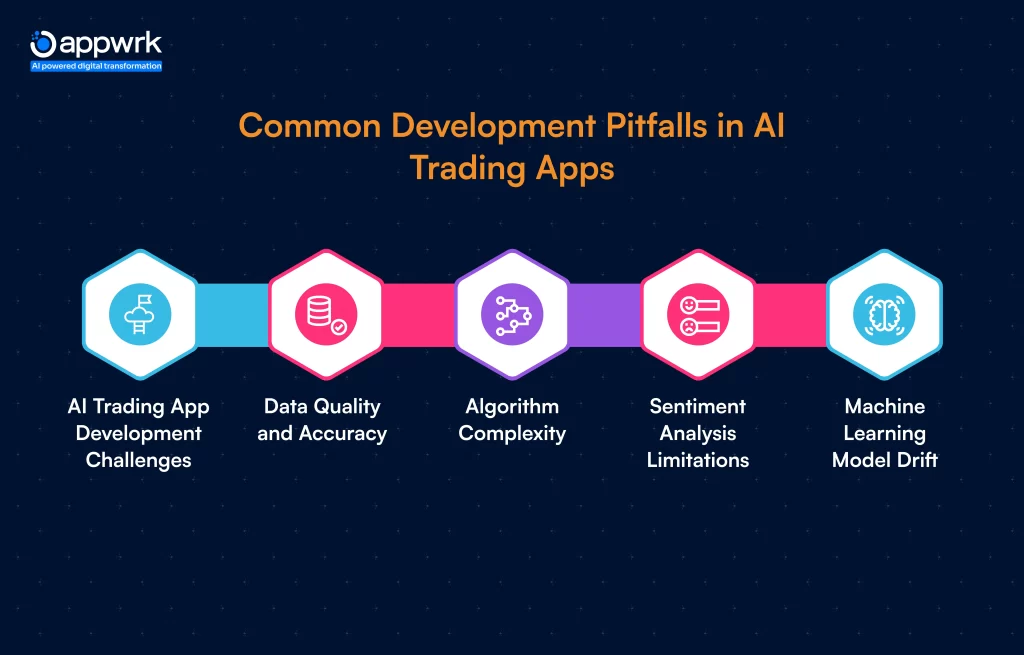
Common Development Pitfalls in AI Trading Apps
Despite the promise of AI in trading, many platforms stumble due to strategic and technical oversights. Whether it’s overestimating algorithmic intelligence or underestimating market complexity, these pitfalls can derail product timelines, erode user trust, and attract regulatory scrutiny. For fintech innovators, understanding these traps upfront is crucial for building resilient, compliant platforms.
AI Trading App Development Challenges
One of the most common challenges is the disconnect between theoretical AI models and their real-world performance. Backtests may look impressive, but live markets are filled with edge cases, liquidity shifts, and sudden events that stress-test even the best-trained models.
Another core issue is data drift, where live market data gradually changes in structure or behavior compared to training data. Without a continuous learning pipeline, models become stale and risk underperforming or producing inaccurate signals.
Data Quality and Accuracy
AI trading platforms are only as good as the data they ingest. Poor data quality, like missing values, unstructured formats, or delayed feeds, results in poor predictions and unreliable trading decisions. Many startups fail to invest in proper data validation pipelines and monitoring tools, leading to compounding errors that go unnoticed until financial losses occur.
Real-time systems also require ultra-low latency data delivery. Even milliseconds of delay in high-frequency environments can translate into significant slippage or missed trade opportunities.
Algorithm Complexity
Overly complex models can become black boxes, which are difficult to explain, debug, or optimize. While deep neural networks and ensemble models are powerful, they often require intensive compute resources and careful tuning. Simpler, interpretable models often yield similar performance when well-trained on clean data.
Additionally, the integration of complex AI logic into live trading stacks often creates bottlenecks. Poor orchestration between models and order execution layers leads to timing mismatches and failed trades.
Sentiment Analysis Limitations
Many trading bots attempt to incorporate sentiment analysis from news or social media using natural language processing. But this can backfire when language is ambiguous, sarcastic, or taken out of context. Without domain-specific training and disambiguation models, sentiment signals often mislead bots into making poor decisions.
Moreover, over-reliance on trending sentiment can create herd behaviors, amplifying volatility rather than stabilizing strategies.
Machine Learning Model Drift
Model drift, the phenomenon where model performance degrades over time, is particularly acute in fast-moving markets. It occurs when the statistical properties of input data change, making past training obsolete.
To counter this, teams must implement continuous training cycles, validation mechanisms, and drift detection tools. Ignoring this reality is a leading cause of silent system failure in deployed AI trading platforms.
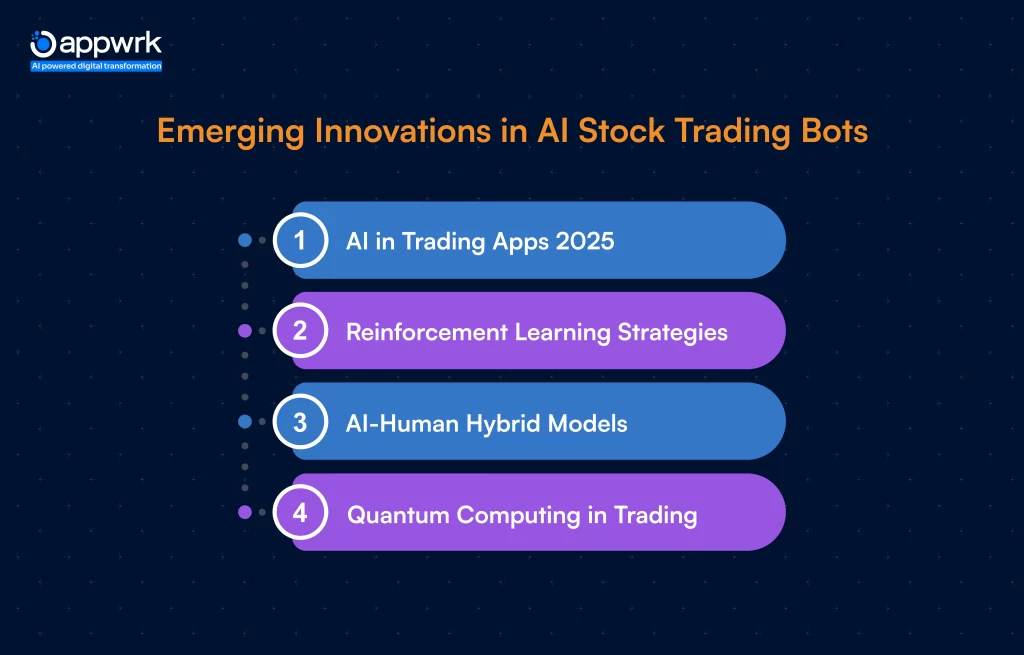
Emerging Innovations in AI Stock Trading Bots
AI trading bots are rapidly evolving beyond rule-based automation and static models, entering an era defined by real-time learning, contextual reasoning, and autonomous decision-making. Breakthroughs in generative AI, reinforcement learning, and multi-agent systems are pushing the boundaries of what’s possible in market prediction, execution precision, and adaptive strategy.
For fintech innovators and forward-looking investors, staying informed on these advancements is critical to capitalizing on the next wave of intelligent trading.
AI in Trading Apps 2025
By 2025, AI will no longer be a feature, as it will be the operating core of trading systems. Bots will evolve into autonomous agents that monitor macroeconomic data, adjust exposure across asset classes, and explain trade rationales in natural language.
Voice-activated trading, AI-led investor coaching, and hyper-personalized portfolios will become common. These features will blend AI with behavioral science, offering real-time, emotionally intelligent support for every type of trader.
Reinforcement Learning Strategies
Reinforcement learning (RL) is gaining traction as a way for bots to “learn by doing.” Unlike supervised models trained on historical data, RL agents simulate thousands of market scenarios and adapt their strategies based on rewards and penalties.
While computationally intensive, RL enables bots to develop unique edge strategies, such as optimal timing for entry/exit or dynamic position sizing. These models are especially useful in high-frequency and options trading environments where precision is critical.
AI-Human Hybrid Models
Rather than replacing human traders, AI is increasingly used to enhance their decision-making. Hybrid models allow traders to set strategic objectives while AI handles execution and optimization. This co-pilot model is gaining favor in wealth management platforms, hedge funds, and institutional desks.
These systems also include “explainability layers,” where AI models provide context around why a trade was suggested, how risk was assessed, and what data influenced the decision, bridging the gap between black-box AI and transparent strategy.
Quantum Computing in Trading
While still in early stages, quantum computing holds the potential to revolutionize AI training and financial modeling. Quantum algorithms could process massive multidimensional datasets in seconds, enabling bots to consider far more market variables in real-time.
Firms exploring this frontier are experimenting with quantum-inspired optimization for portfolio management, arbitrage scanning, and risk parity calculations. As quantum hardware matures, it could power the next generation of trading intelligence.
Revenue Models and Monetization Paths for AI Trading Apps
AI trading apps offer far more than trading functionality; they unlock diverse and scalable monetization opportunities. From subscription tiers and premium analytics to data licensing and algorithm-as-a-service, the revenue potential extends well beyond traditional brokerage fees. For fintech founders and investors, the key is to align monetization strategies with user behavior, regulatory frameworks, and the unique value created by AI-driven insights and personalization.
Subscription Plans
One of the simplest and most effective ways to monetize an AI trading app is through a tiered subscription model. You can offer a free or low-cost plan that includes basic features like manual trading and delayed market signals to attract a broad user base. Then, reserve advanced capabilities, such as real-time AI-driven alerts, portfolio analytics, and automated trade execution, for premium subscribers.
This approach not only creates a steady stream of recurring revenue but also allows you to segment users based on their trading needs and willingness to pay, making it easier to deliver targeted value at each tier.
In-App Purchases
Monetize specific features through microtransactions. These can include backtesting credits, additional trading strategies, sentiment analysis modules, or premium indicators. This model supports high personalization and increases user lifetime value without overwhelming free users.
Dynamic pricing, where costs scale based on trading volume or market access, also aligns cost with user success, enhancing retention.
Referral Commissions via Financial Advisors
Another smart monetization route is partnering with registered investment advisors (RIAs), brokers, or wealth managers who already have established client relationships. You provide the AI trading technology, and they bring the clients, creating a revenue-sharing model that benefits both sides. This approach allows you to tap into regulated markets without directly managing client funds, while also leveraging the trust and credibility these advisors have built.
Additionally, you can explore affiliate partnerships with platforms like Interactive Brokers, offering users direct access to trading through seamless API integrations, further boosting adoption and revenue.
Data Insights Sales
As your platform collects user behavior, sentiment patterns, and trade outcomes, anonymized data can be packaged into actionable intelligence for:
Hedge funds seeking edge signals.
Market research firms needing behavioral trends.
Media companies looking for real-time investor sentiment.
This B2B monetization stream can be extremely lucrative, especially when AI adds predictive layers to raw data.
Advertising Revenue Models
If targeting retail users at scale, contextual advertising can become a viable revenue stream. Sponsored tools, promoted trade strategies, or AI widget sponsorships can be seamlessly embedded without breaking user trust, provided ads are relevant and disclosed.
Platforms should focus on ethical advertising, avoiding conflicts of interest or manipulation in financial advice presentation.
Key Regional Insights and Trends
AI trading is evolving differently across global financial markets due to variations in regulation, infrastructure, investor behavior, and technology adoption. For fintech companies looking to scale or localize, understanding these regional nuances is critical to positioning their AI trading bots effectively.
USA: Fintech Innovation and AI Trading Startups
The US remains the epicenter of fintech innovation. Silicon Valley, New York, and Chicago continue to incubate AI-first trading startups focused on retail and institutional markets. With relatively open capital markets and deep venture ecosystems, American fintech firms benefit from rapid go-to-market cycles.
Regulatory bodies like the SEC and FINRA are increasingly focused on algorithmic transparency, requiring platforms to provide audit trails and explainable models. Nonetheless, the U.S. market favors disruption, and users are quick to adopt new tech, especially if it offers speed, personalization, or cost savings.
UK and Europe: Regulatory Focus and Financial AI Use
The UK and broader EU markets are leading the charge on AI regulation in financial services. MiFID II and GDPR enforcement mean platforms must prioritize data privacy, consent management, and model explainability from day one.
At the same time, London, Frankfurt, and Amsterdam remain major hubs for quantitative trading, with hedge funds actively deploying AI models for arbitrage and sentiment analysis. Sandbox environments run by the FCA provide a testbed for AI trading innovation under controlled oversight, accelerating institutional adoption while maintaining regulatory integrity.
Australia: Investment Platforms and AI Penetration
Australia’s fintech market is highly competitive, especially in retail investing and robo-advisory sectors. Trading apps like SelfWealth and Stake are embracing AI features for user engagement, though full automation adoption is still growing.
The Australian Securities and Investments Commission (ASIC) maintains strict licensing requirements, which make compliance-heavy AI solutions more viable than experimental bots. However, interest in ethical investing, ESG modeling, and AI-driven research tools is rapidly increasing across both consumer and institutional segments.
Global Comparisons and Market Readiness
While North America leads in AI infrastructure and capital availability, regions like India, Southeast Asia, and the UAE are catching up through regulatory reform and startup accelerators. Each market presents a unique mix of investor behavior, device penetration, and preferred asset classes.
For example, Southeast Asia sees higher crypto usage in retail trading, while Nordic countries lean toward sustainability and long-term investing models. AI trading platforms that align with local values and trading cultures are more likely to succeed globally.
Regulatory Variations in Major Financial Markets
Across markets, AI compliance frameworks are evolving:
The EU AI Act may soon require clear labeling, bias audits, and human oversight for all high-risk AI models.
The SEC is introducing more stringent oversight for algorithmic trading systems and dark pool activity.
Singapore and UAE are positioning themselves as AI innovation hubs with fast-track licensing programs for fintechs.
These differences affect development roadmaps, go-to-market strategies, and investor trust. Localized compliance must be baked into the product architecture to scale sustainably.
How APPWRK Helps
Building an AI stock trading bot requires more than just coding expertise. It demands strategic alignment, financial acumen, and regulatory foresight, all of which APPWRK delivers through its full-stack AI development solutions. Whether you’re a fintech startup, institutional investor, or product leader aiming to disrupt trading, APPWRK brings the expertise and execution muscle needed to go from idea to impact.
AI App Development Expertise
APPWRK specializes in AI-first fintech products, with a proven track record in designing, training, and deploying predictive models for stock and crypto trading. Our team works across machine learning disciplines, from supervised learning to reinforcement strategies, ensuring models are not only accurate, but also explainable, scalable, and robust under market pressure.
We tailor AI pipelines to support real-time signals, anomaly detection, backtesting engines, and continuous learning loops.
Full-Stack & Cross-Platform Capabilities
Our engineering teams deliver cross-platform experiences, like web, iOS, Android, powered by responsive frontends and secure, event-driven backends. Whether you need a mobile trading app for retail users or a dashboard for institutional analysis, Appwrk builds it with modular architecture and seamless API integrations.
From UI/UX design to cloud DevOps, our full-stack capabilities ensure your AI trading bot delivers performance and usability across platforms and user types.
Compliance-Focused Development
APPWRK bakes compliance into every layer of development. We build products that align with FINRA, SEC, GDPR, and MiFID II standards, ensuring your platform can scale globally without regulatory friction.
We implement audit trails for AI decisions, KYC/AML features, and model transparency mechanisms that reduce legal risk and build institutional trust.
Customizable AI Solutions for Fintech
Every client’s trading strategy is unique. That’s why we don’t push one-size-fits-all templates. APPWRK offers custom model development, architecture consulting, and strategy simulation tailored to your goals, whether it’s equities, options, crypto, or ESG-focused portfolios.
Our proprietary AI frameworks are built to integrate with your brokerage APIs, data providers, and compliance systems, accelerating time-to-market and improving ROI.
From ideation to post-launch optimization, APPWRK remains a strategic partner. We help you define MVP scope, build and test AI models, deploy at scale, and monitor user behavior post-launch. Our support doesn’t stop at deployment, but we also offer ongoing model tuning, feature rollouts, and performance optimization as your trading platform grows.
Clients benefit from dedicated account managers, real-time communication, and agile delivery cycles.
Contact APPWRK to get a custom AI Trading Bot with Advanced Features.
FAQs
1. What is the cost to develop an AI stock trading bot in 2025? Development typically starts around $10,000 for MVPs, covering basic AI logic and trading execution. Mid-tier bots range from $60,000 to $180,000, while enterprise-grade platforms with deep learning, multi-asset support, and compliance features can exceed $500,000, depending on complexity and region.
Looking for a tailored cost estimate? APPWRK can help you assess the right AI Trading bot stack based on your budget and goals.
2. What factors influence the cost of AI trading app development? Major cost drivers include AI complexity, real-time data processing, compliance readiness, infrastructure needs, and integration with brokerage APIs. Apps requiring reinforcement learning, 24/7 execution, or institutional-grade compliance can see 2-3x cost increases.
3. How can AI trading bots ensure regulatory compliance? Compliance involves secure data handling, explainable AI models, audit trails, and integration with legal frameworks like FINRA, SEC, GDPR, or MiFID II. Bots must support human overrides, real-time monitoring, and decision transparency to meet legal standards.
4. What are the best ways to reduce AI development costs without sacrificing quality? Start with a modular MVP, then scale. Use open-source libraries (e.g., TensorFlow, FastAPI), limit features to essential trading logic, and avoid early integration of high-frequency or multi-asset systems. Outsourcing non-core functions like frontend or DevOps can also cut costs by up to 40%.
5. Can AI bots be integrated with existing trading platforms and APIs? Yes. Most AI bots support integrations with brokers like Interactive Brokers, Alpaca, or TD Ameritrade. Standard APIs, webhooks, and cloud-native services allow for seamless deployment within existing infrastructure or as white-label solutions.
6. Are AI trading apps secure for handling financial data and transactions? With proper encryption, multi-factor authentication, and secure APIs, AI trading apps can be highly secure. Enterprise platforms often implement end-to-end encryption, IP whitelisting, and automated threat detection to meet financial-grade standards.
7. How do AI trading bots handle options, crypto, or multi-asset portfolios? Bots can be trained for various asset classes. Options trading bots incorporate volatility models and Greeks, while crypto bots rely on real-time sentiment and arbitrage strategies. Multi-asset bots require more complex logic and asset-specific data pipelines.
8. Can AI outperform traditional rule-based trading systems? Yes, especially in volatile or data-rich environments. AI models adapt to evolving market signals, learn from historical performance, and adjust strategies dynamically, often outperforming static rule-based systems in speed and precision.
Gourav Khanna is the Co-founder and CEO of APPWRK, leading the company’s vision to deliver AI-first, scalable digital solutions for enterprises and high-growth startups. With over 16 years of leadership in technology, he is known for driving digital transformation strategies that connect business ambition with outcome-focused execution across healthcare, retail, logistics, and enterprise operations.
Recognized as a strategic industry voice, Gourav brings deep expertise in product strategy, AI adoption, and platform engineering. Through his insights, he helps decision-makers prioritize market traction, operational efficiency, and long-term ROI while building resilient, user-centric digital systems.
Subscribe to APPWRK Blogs, We'll Do the Rest!
Get Blogs on UI/UX, Mobile Apps, Online Marketing, and Web development technology.
Unlock worthy and priceless suggestions from the masters of mobile and web app development