150+ minds across 4 countries. Join a culture of innovation, ownership & growth.
Rewire for AI
From machine learning to deep learning, from classification tools to overall process automation – our AI engineers will help you retool your existing system or enhance your company results.
Ship faster, scale smarter, built for product companies and SaaS teams
Our Latest Work
We strive hard to deliver result-driven digital solutions across the globe. Check out our case studies to get a glimpse of how we ideate, innovate, and create unconventional digital solutions according to the requirements of our clients.
Discover diverse and passionate insights from our tech enthusiasts. We collaborate across various sectors to streamline operations and drive innovation. Explore our rapidly growing collection of articles to see why we’re at the forefront of IT solutions.
The decision to move from Magento to Shopify is one of the most significant replatforming choices an ecommerce business can make. Magento is powerful, but its power comes with...
Accuracy gap is real: Traditional CPG forecasting carries a 25-40% MAPE error rate. AI-powered models bring that down to 8-15%, according to McKinsey research....
If you’re launching a website, you probably want it ready as fast as possible. However, it’s difficult to gauge the average time to develop a site if it’s your first time commissioning one. Without that information, you might end up hiring the wrong team for the job.
Using Webflow is one of the easiest and quickest ways to build a decent website. Webflow is a very easy-to-use in-browser design tool that allows you to design and build professional websites without writing the nitty-gritty code. It has live prototyping that eliminates the barrier between the final product and the two-dimensional visual design mockup and allows you to make changes in real time and quickly get direct access to the final website. Webflow also has a sophisticated, custom client-facing Content Management System (CMS) that allows you to easily add new portfolio items, blogs, and services to your website.
If you are interested in knowing all these things and more, sit back and continue reading until the end of this article.
To know more about: What is Webflow, its features, benefits, etc. Read the most detailed article.
Project Scope: From Landing Pages to Massive Websites
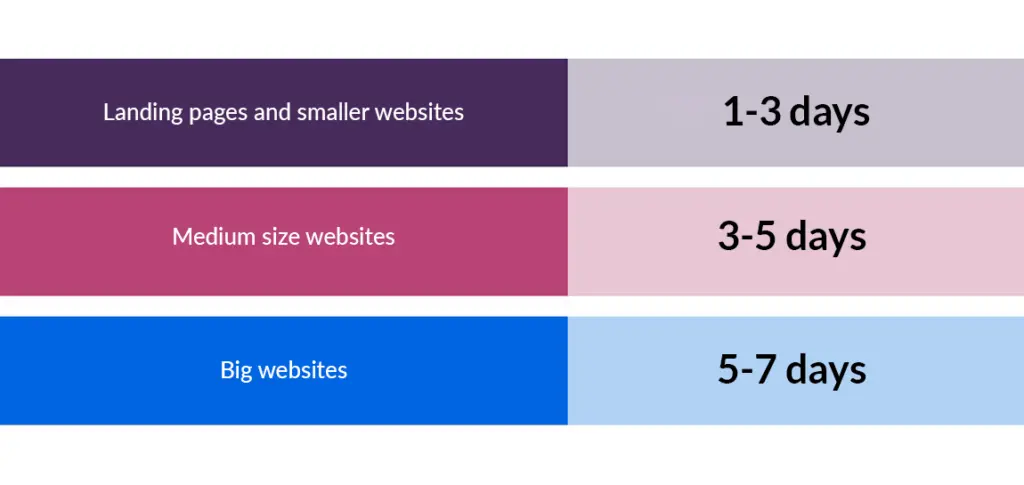
You can build responsive websites with high-level functionality with Webflow in just a fraction of the time compared to other website builders requiring code writing e.g.WordPress, Shopify, and Magento. If you hire Webflow developer or designer you can build the website within a week, depending on the project’s scope.
A landing page is a small, standalone web page often built for advertising campaigns or digital marketing. Since it is a standalone web page, it is considered a separate entity that doesn’t need to follow the established guidelines and rules of the existing website. Landing pages only contain minimal information about the company, product, or services. They likewise only have limited features and functionality; that is why they are quick to build.
You can build a smaller website quickly since it only consists of at most five pages. Most often, small websites only have essential pages like the home page, company about us page, contact page, and product page.
Medium size websites: 3-5 days
Webflow websites consisting of 6 to 10 pages are considered medium size websites. Aside from the essential pages mentioned above, medium size websites also have additional pages like blogs with a career page, CMS, portfolio pages, and detailed product pages, to name a few. We can create a dynamic medium size Webflow website within 3 to 5 days.
Big websites: 5-7 days
Big Webflow websites are those websites consisting of at least 10+ pages. Often, these websites contain several repetitive product or service pages, different page layouts, and various types of content that need to be structured in different ways. Developers and designers also need to spend enough time on the blueprint to ensure everything is well-thought-out, on-point, functional, and perfect. Webflow developers will need at least 5 to 7 days to complete an entire website. More time may be necessary for complicated websites that require more complex functionalities, tools, and add-ons.
Now that you know how much time you may need to build a website based on its scope or size, let us check out the different stages affecting web development time.
Build Amazing Webflow Websites in No Time!
Not months. Not weeks. Build your professional site in a few days. 200+ projects delivered under 7 days.
How Do the Different Stages of Development Affect the Average Time to Develop a Website?
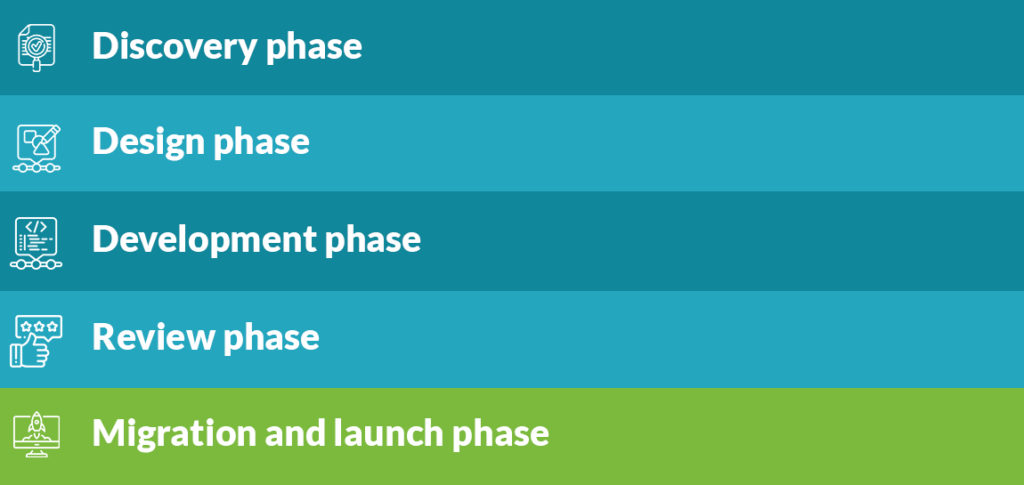
Website development is divided into five main stages. These stages are:
Discovery phase
Design phase
Development phase
Review phase
Migration and launch phase
Each of these stages or phases requires a specific amount of time. Let us dive deeper into what these stages are all about so we can estimate the average time to develop a website.
Discovery phase
The first stage of building a Webflow website is the discovery phase. This stage includes:
Planning. Depending on the website’s scale, scope, and complexity, planning can take anywhere between an hour and a day. The primary aim of the planning stage is to lay out everything needed for website development so you will be fully prepared before starting the design process. During the planning stage, it is critical to determine and understand the following things:
Objective, goal, or purpose of the website
Features of the website
Structure of the pages and content
User experience
Size and scale of the website
performance requirements
MVP scope and timelines, and more!
Market analysis. Market Analysis is extremely complex work. It would be best to get that work done by an expert webflow developer that would examine every critical aspect.
Acquisition of information. The next step is to gather related information and organize them accordingly. The Acquisition of information step also includes planning, creating, and preparing all the content. This stage will take only a few hours if the Webflow development team is already provided with the content needed for the website. However, if the team still needs to create the content from scratch, you can expect this stage to take a few days to complete depending on the amount of content the team needs to generate.
Design phase
The design phase is when you turn your vision into an actual, functioning Webflow website. During this phase, you begin designing and building the components of your website, the web pages, and the user interface. The good thing about Webflow is that it offers a large pool of features and tools that you need to build a responsive website like templates, CMS, marketing tools, eCommerce tools, and website builder, to name a few. These things make it possible to finish the design phase in just a few days.
Development phase
The development phase is the most complicated and time-consuming for most website development projects. This phase can take anywhere between 1 to 3 weeks. However, since Webflow does not require coding, building a website can only take a couple of hours to days.
Review phase
Before launching the website, you must have it tested and reviewed first to ensure everything is working 100%. The amount of time this phase will likely consume will depend on how many issues you find during the review and whether they require minor or major fixing.
Migration and launch
Now that all the parameters are fulfilled, it is time to launch the website finally. This stage can take at least an hour for simple websites and a day for big websites. After launching the website, you may need to make changes until everything works and looks perfect.
Factors That Impact the Average Time to Develop a Website
Building a Webflow website may take a few days to a few weeks depending on the following factors:
The goal of a Website
The Complexity of Business Logic
The Level of the Team Involved
Factor 1. The goal of a website
What is the purpose of your future Webflow website? The goal of a website defines the timeline of your website development project. Knowing the goal and purpose of the website will help you determine the business logic.
For instance, if your goal is to build a landing page or a small website that you can use to promote your brand, the building process may only take a day or two. However, if you want to build an eCommerce store or a large website that requires special customization, you can expect to complete the entire development process within seven days.
The rule of thumb states that the more features you want to incorporate into a website, the more time is needed for the development, and the higher the cost will be.
Factor 2. The Complexity of Business Logic
The complexity of business logic is determined by the number of features and roles your website will have. The complexity of the features will also define the complexity of the business logic.
Factor 3. The Level of the Team Involved
The process of website development consists of different stages. Each stage will require different skills and requirements. Regardless of the scope, scale, and complexity of the project, your web development team must include the following professionals:
Project manager
Marketing Manager
Business analyst
Backend web developer
Markup developer
Frontend web developer
UX/UI designer
QA Tester
In general, do-it-yourself website building can take between two to six weeks. Suppose you wish to expedite the entire process and achieve a higher quality website. In that case, you need to consult a Webflow design agency or simply hire Webflow developers and they will take care of everything!
Interested in Learning More about Webflow Design and Development?
You now know the average time to develop a website using Webflow, right? If you wish to learn more in-depth knowledge about the design and development time and cost of a Webflow website, you can refer to our detailed guide on “How Much Does It Cost To Build A Webflow Website?“
Gourav Khanna is the Co-founder and CEO of APPWRK, leading the company’s vision to deliver AI-first, scalable digital solutions for enterprises and high-growth startups. With over 16 years of leadership in technology, he is known for driving digital transformation strategies that connect business ambition with outcome-focused execution across healthcare, retail, logistics, and enterprise operations.
Recognized as a strategic industry voice, Gourav brings deep expertise in product strategy, AI adoption, and platform engineering. Through his insights, he helps decision-makers prioritize market traction, operational efficiency, and long-term ROI while building resilient, user-centric digital systems.